 How to resolve AdBlock issue?
 The Crow Hill Company GONG PIANO
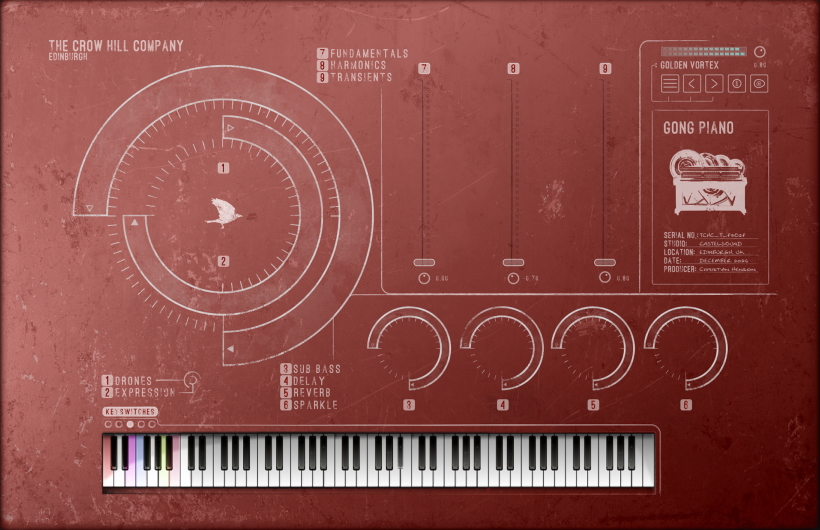
The Crow Hill Company introduces its latest innovations in sampling with GONG PIANO - embracing entirely new concepts (including so-called Shepherd Mapping polyphony, as well as recording Partials), engine, GUI (Graphical User Interface), and an environment to work in that is firmly pegged and duly designed to deliver for music-makers wanting cinematic results in an instant as a drone-making, super-chromatic gong machine, to paraphrase the driving force behind its ear-opening creation - as of February 26…
Put it this way: in Roland parlance, Partials refer to the foundational, discrete sound-generating components within many of that Japanese giant’s synths, classic or otherwise, whereby each ‘tone’ (sound) can consist of up to four individual Partials, allowing for complex, layered, and evolving sound design. “When recording these gongs, I always had in mind that we were going to separate them off into Partials,” confesses Christian Henson, adding: “I did the first round of recordings in the house and then tried two different forms of post-production to create the Partials - one was using iZotope, whereby, once you’ve removed the fundamentals, it’s quite easy to see the harmonics and just leave the transients; however, there’s a kind of noise reduction-y, digital squarbly sound that is really apparent that I’m very sensitive to these days, so I decided to do the post-production process again on those same recordings, but this time by using strong or stacked band-passes, high-passes, low-passes, and, again, when putting that together, it just felt like when you freeze some vegetables - they never quite taste like fresh vegetables again. So what I decided to do was to go into a more controlled environment - that being Castlesound Studios, where I’ve got some of the best recordings I’ve ever had the pleasure of being part of making, with the decision to use a selection of beaters but also different positions within the gong and, instead of creating Partials from single recordings, using multiple recordings to basically combine these three Partials - three totally separate recordings - into the sound that we’ve created. Am I trying to make a realistic rendition of this gong? No. I’m just trying to create something that is suitable for us composers as a drone-making, super-chromatic gong machine, but something that still sounds realistic.”
It is worth, perhaps, pausing briefly here to point out that those same gongs have already made an outing - albeit in a somewhat simplified sampled-based virtual instrument plug-in form - on The Crow Hill Company’s free VAULTS - TUNED GONGS, relatively recently released as a downloadable drop with a difference, effectively enabling anyone to play an extraordinary quartet of harmonised gongs designed and used by meditation gurus as part of gong bath setups in a way that was never intended by their Italian creator after being bought and sampled by Christian Henson.
Embracing entirely new concepts warrants an entirely new GUI to operate the new engine driving GONG PIANO: “When you see a bunch of faders on our new GUI, it means something entirely different - three Partials: the FUNDAMENTALS, the HARMONICS, and the TRANSIENTS. The fundamental samples work just like your traditional Akai samplers; there’s a lot to be said for all that magic that happens when you pitch something down loads - and, indeed, pitch it up, but down is better. So there’s a lot of fundamental tone here; we’re hitting the gong in the part of it that produces the greatest, roundest, fattest fundamental. There’s enough interesting harmonic material in there to create real interest across the keyboard, with a very pure, sine wave-type tone down at the bottom, but with all sorts of movement and fluctuation. No surprises here, then; however, if we move to the next Partial, this is the part of the gong that creates the biggest amount of interesting harmonic information - less fundamental and more of the surrounding harmonics. Finally, the TRANSIENTS is the aspect of the gong that creates the least recognisable fundamentals or harmonics. Whilst these gongs resonate at different fundamental frequencies, they’re all made of the same thing - metal, and, no matter what happens to that central resonating frequency, the thing that you can never get away from is material - what they’re actually made of. So what I’ve decided to do with the TRANSIENTS is keep the pitch static - loads of dynamic layers, loads of round robins, so you don’t get a sense of things repeating themselves, but it always stays the same pitch. So what I decided to do was take the harmonic Partial, duplicate it an octave apart, and gradually adjust the mix of that octave unison across an octave so that - whilst it will move pitch with the fundamental across the entire spread of the keyboard - the fundamental harmonic qualities of the instrument won’t change. And what I’ve created is basically a chromatic shepherd tone. The variable Partial, the static Partial, and this kind of hinterland between give the gong its characteristic - the FUNDAMENTALS, the HARMONICS, and the TRANSIENTS. This is just one gong - one pitch centre - that we’ve managed to divide into these Partials, spread across a keyboard, and what I love about it is the tonal change in characteristics depending on the pitch - the change in kind of emotional effect, but, to my ears, it doesn’t just sound like a sample that’s been pitched up and down.”
Featuring four handcrafted tuned gongs from Grotta Sonora in Rome, Italy, recorded with five microphones (Super Close Mono: U87, Close Stereo: 2 x U47, Room: DPA ST4006A) at Castlesound Studios in Edinburgh, UK, GONG PIANO is available to buy for £29.00 GBP as an AAX-, AU-, VST-, and VST3-format-compatible sample-based virtual instrument plug-in comprising 10GB of uncompressed material (compressed losslessly to 5.5 GB) that loads directly into a DAW (Digital Audio Workstation) - with four unique sounds sets with five articulations (Multi-Hit, Muted, Metal, Harmonic Mutes, Scrapes & Swipes) each, plus an additional Drone layer, as well as three individually controllable Partial Tones (FUNDAMENTALS, HARMONICS, TRANSIENTS) and four included effects (SUB BASS, DELAY, REVERB, SPARKLE) - from The Crow Hill Company website.