 How to resolve AdBlock issue?
The Crow Hill Company BROTHER TREE SOUND
The Crow Hill Company announces the availability of its BROTHER TREE SOUND storytelling strings library plug-in — produced as a result of an extraordinary week of sessions between Brother Tree Sound, itself formed in 2017 out of a love for the powerful intimacy of the string quartet, and BAFTA Award-winning composer Christian Henson, himself the co-founder of the Edinburgh-based enterprise concerned, creating its first library using a so-called ‘fragmentary’ approach to sampling to produce a truly realistic multi-sampled virtual instrument not made from samples but rather fragments of performances to give the user as close an experience to working with a live band as humanly possible without actually picking up the phone and booking one — as of November 3…
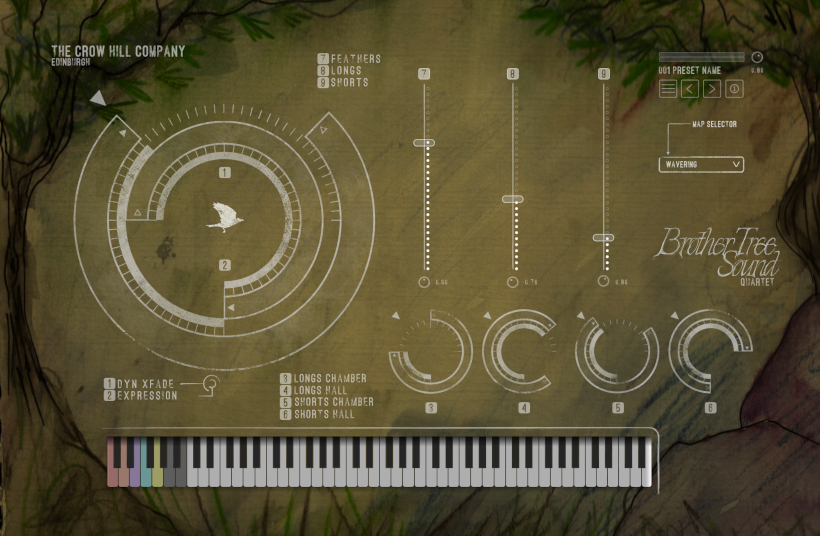
Getting to grips with BROTHER TREE SOUND’s superficially similar-looking GUI (Graphical User Interface) is as easy as it is with many recent releases from The Crow Hill Company. Christian Henson helpfully provides a guided tour — complete with welcomed insider insight. “Where a lot of libraries — some of which we’ve made — have a mixer that controls different signals — close, wide, and ambient, we decided to use our hard drive space to store what I think is a more useful set of tools,” he begins, before continuing thusly: “What you get here is a stereo mix, but separated on a mixer with what we call Partials — parts of sound. We borrowed this term from the success of Roland’s D-series synths in the late-Eighties and Nineties. So the FEATHERS are these notes that start from an inert state. What I’ve noticed when listening to strings is that there is this feathery kind of crunch, and it’s basically laws of physics — getting something still to move or change direction creates friction before the resonance happens. The FEATHERS are controlled by velocity — how hard you hit your keyboard, or, indeed, if you want to do all this by automation then pull up the velocity lane on your DAW [Digital Audio Workstation] track.
The LONGS are cut from performances. We recorded up to four dynamic layers, so something that’s really exciting about this library is that you have stuff like Sul Tasto — which tends to always be quiet in libraries — that goes through the full dynamic range; the DYN XFADE control is connected to the CC 1 MIDI [Musical Instrument Digital Interface] control value, which is, on most keyboards, your modulation wheel. We’ve also allowed the player to control some of the volume of each note with velocity, but it’s not going through the different dynamic layers. And what this enables us to do is to dig out melodies within harmonic sequences — allows for all sorts of expressive nuance. EXPRESSION is CC 11 — basically just a trim control over volume as an additional form of expression; there’s a tiny bit of a filter on there, so as you wake it up it just gets that slightly bit brighter. I think it’s a more effective way of being able to carve out melodies than using these slightly awkward-to-use legato things, which I’m not a fan of. There’s something aggressively-put-musicians-out-of-work-y about legatos that I don’t enjoy. And, wherever possible, I’ll always use live musicians — even if it’s just a solitary player to really help with those in-between-y bits that really characterise a performance.”
Christian Henson has this to say this about the GUI: “The third [SHORTS] fader is a new thing I’m trying; I’m not a fan of the key switch thing when switching between articulation styles — namely, SHORTS and LONGS, so I thought, ‘Why don’t we just stick it on a fader, so you can bring it up and down.’ Because the dynamics [DYN XFADE] fader is controlling the dynamics of the LONGS, if you bring the SHORTS one up then you obviously have the freedom to then totally isolate the Shorts, which are operated with velocity — just like the FEATHERS. There are strings libraries with tighter shorts, but I was really strict with the production team — myself included as I was part of the editing team — about us really capturing the full length of the note, from the moment that the bow first meets the string and is really encouraging it to resonate into some semblance of a note, which just gives you something that’s so much more realistic.” Realism also dictated that those LONGS and SHORTS should each be blessed with their own dedicated reverb controls — namely, LONGS CHAMBER, LONGS HALL, SHORTS CHAMBER, and SHORTS HALL.
Having said all that, then, the end result surely speaks for itself — a plug-in with notable scope (courtesy of 22 unique articulations/playing styles with LONGS samples matched with a complement of SHORTS and FEATHERS), dynamic range (up to four layers for LONGS and SHORTS), and humanism (up to 15 round robins per articulation). As a group of composers, The Crow Hill Company collectively found the energy, inspiration, realism, soul, and surprises drawn from BROTHER TREE SOUND surpasses anything it has experienced using a strings virtual instrument thus far — including its own! Original, deeply multi-sampled, and never-before-heard articulations, born of a shared goal between players and producer to make something entirely new, wholly spirited, and full of human surprises, with a wide variety of storytelling possibilities perhaps best sums up BROTHER TREE SOUND.
BROTHER TREE SOUND is available to purchase — priced initially with a limited early-access offer of £125.00 GBP/€139.00 EUR/$169.00 USD until December 1, 2026 (rising thereafter to its regular price of £179.00 GBP/€199.00 EUR/$239.00 USD) — as a sample-based virtual instrument comprising 4.4 GB of uncompressed Audio supporting AAX-, AU-, VST-, and VST3 plug-in formats for macOS 12 through to 15 (Apple Silicon and Intel compatible) and Windows 10 through to 11 — from The Crow Hill Company’s online Shop. BROTHER TREE SOUND installation and activation requires installation of The Crow Hill App — an easy-to-use app designed by the best in the business to provide seamless download, installation, integration, calibration, and organisation of The Crow Hill Company tools — available for free from the website below.