 How to resolve AdBlock issue?
 The Crow Hill Company THE SH*T SYNTH
The Crow Hill Company turns to its own extensive and rare collection of hardware to turn out THE SH*T SYNTH — available as a compendium of 48 circuit-, wave- and sample-bent instruments inspired by some of the Edinburgh-based enterprise’s eclectic musical favourites (spanning the likes of Aphex Twin, Boards Of Canada, Joe Maus, Jon Brion, Laurie Spiegel, Radiohead, Throbbing Gristle, and Yazoo) to create something that they collectively ask: is it just shit or ‘the shit’? — as of April 7…
Whatever way anyone chooses to read into the titling of THE SH*T SYNTH as the latest entry into The Crow Hill’s ongoing ORIGINS series of sample-based virtual instrument plug-ins, one thing is for sure: it readily represents a broad selection of three categories of 16 workhorse instruments each, effectively wrapped up into a single plug-in designed to bring a cohesive approach to making music more edgy, lo-fi, retro, and - swimming against the technological tide of so-called progress - decidedly AI (Artificial Intelligence) slop-free. From pianos to strings, plucks, beeps, bass, and pads, the compendium that is THE SH*T SYNTH has been lovingly sculpted by the Edinburgh-based enterprise’s media composer and ‘samplist-in-residence’ Christian Henson to take the hassle out of making existing sounds less refined, catering to those looking for an entirely new bank of Mellotron-style sounds as well as synths that have been long forgotten - for good reason.
That all being said, Christian Henson has not forgotten how THE SH*T SYNTH ultimately came to be - admittedly quite some considerable time after an adventurous sampling journey first got going: “About 20 years ago, I made a sample instrument that broke all the rules; it had bad tuning, bad playing - was badly recorded, and it changed my life. Since then, I’ve made hundreds of sample instruments, but none of them were as badly tuned, badly played, or badly recorded. What went wrong? I’d been listening to some of my favourite albums and realised that a lot of them have bad sounds, but with good notes put in a good order. So I thought: ‘Why don’t I go back to my roots and find another route with sounds that I make - actual instruments that start bad, have seen better days, or, indeed, go into the box already harmed, without the need of the contrivance of harming them digitally once they’re in there?’ So, as part of my ORIGINS series - building the sounds that I use, the tools of my trade, from scratch, I thought I’d make this, THE SH*T SYNTH! There are 16 instruments, but each of those is made up of three different sets of raw materials - one from an ANALOGUE source, one from a DIGITAL, and one from a SAMPLED.”
Specifically, those 16 instruments are: 01 PIANO, 02 E PIANO, 03 BASS, 04 BEEPS, 05 PLUCKS, 06 PADS 1, 07 PADS 2, 08 ORGAN, 09 BELLS, 10 GUITAR, 11 STRINGS L (long), 12 STRINGS S (short), 13 BRASS L, 14 BRASS S, 15 REEDS L, and 16 REEDS S. And all can be immediately animated. Adds Christian Henson: “To manage expectations, analogue synths don’t make great piano sounds.” Speaking of which, synths sampled included the much-loved Roland JX-3P, a Programmable Preset Polyphonic Synthesizer - hence the three ‘Ps’ in its name - dating back to the dawn of MIDI (Musical Instrument Digital Interface) in 1983, and a Sequential Circuits Prophet VS, famed for being the first to use Vector Synthesis in 1986, allowing users to mix four digital waveforms per voice via a joystick, combining that digital, overtone-rich sound with analogue Curtis filters.
Spanning synths to stalwart electric pianos and acoustic instruments, many of the instruments sampled have that all too troubling sound of electronic relics teetering on the brink of failure - a little bit shit, but the good shit, so to speak. “Sampling is like pottery; when you load a thing in a kiln, you never quite know how it’s going to come out.” So says Christian Henson, adding: “And I really didn’t expect the brass part of this synth to be my absolute favourite - particularly the ANALOGUE BRASS.
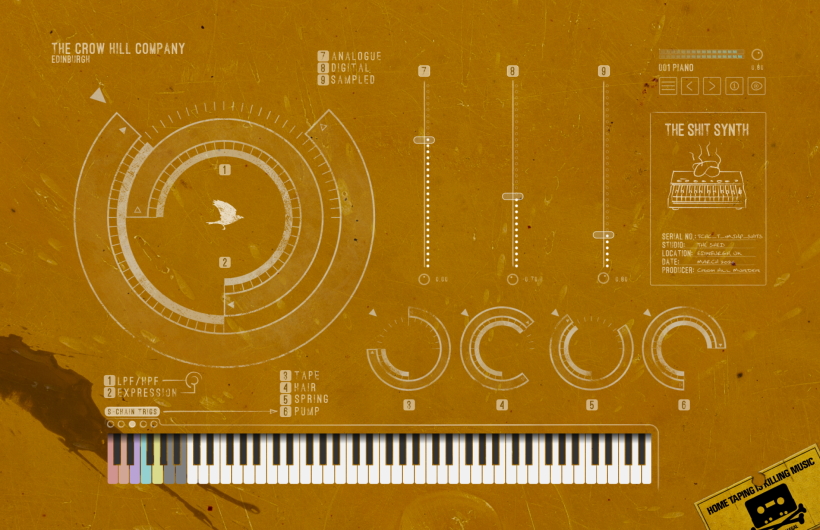
Christian Henson helpfully gives a guided GUI (Graphical User Interface) tour thusly: “The little knob [1] or dial - depending on what part of the world you’re from - is EXPRESSION, so just volume. With the big dial [2], we have LPF / HPF - a low-pass filter/high-pass filter, low-pass being the filter that chops off all the high stuff and allows low stuff to pass through at a frequency that depends on how high or low you’ve set it, and high-pass is the other way round; the reason we put it on the big knob is that I think it’s a really useful form of expression - particularly with very static sounds like that BRASS. Then - number 3 - we have TAPE, which is a tape effect, where the phase flips when you switch it on, but not in a contiguous manner - there’s all sorts of breakups, warbles, and wow-and-flutter.
Then we have HAIR [4], which is a phrase I’ve nicked off somebody who worked with Tom Waits, who apparently has a fader on his mixing desk called hair; this gives quite a lot of welly, or a bit of bottom end, so where you’ve got sounds that are lacking in bottom end, it’s really useful as a way of dialling in some lower harmonics, but if you don't like the bottom end that it adds in, or it becomes overwhelming, that’s when you can nudge your filter dial forward into HPF-ville. For SPRING [5], we’ve convolution sampled one of our spring reverb tanks - not sure which one, but whichever one sounded the worst! It adds these incredible harmonics, and the reason why I find those harmonics useful - particularly as they fluctuate like a reverb would - is that a lot of these sounds are very pure sounding, so spring reverb is an excellent way of adding some organic energy, particularly to analogue sources.
Saving the most fun bit until last, PUMP [6] is connected to these bottom five S- CHAIN TRIGS keys - five fingers, five notes starting at C; basically, they are a bunch of triggers that you’re never going to hear - different shapes that, instead of coming out of the output, go into a side-chain and that side-chain is fed into a compressor that reacts against those triggers to give you a ‘pumping’ sensation, so what dial number 6 does is control the amount - I guess it’s the threshold - that those triggers ‘pump’ your sound with via their different shapes.”
So is THE SH*T SYNTH truthfully ‘the shit’? Or, as Christian Henson himself semi-seriously infers, “… is it something that you’d close the door behind and warn your flatmates to give it 10 minutes!” It is fair to say that The Crow Hill Company has gone to a sonic place many would not dare to tread… time to wash hands while listeners clean out their ears, even!
THE SH*T SYNTH is available to buy for £29.00 GBP as a sample-based virtual instrument plug-in supporting AAX-, AU-, VST2-, and VST3 formats for macOS 11 through to 15 (Apple Silicon and Intel compatible) and Windows 10 through to 11 directly from The Crow Hill Company here.