 How to resolve AdBlock issue?
 Thephonoloop outlines VI
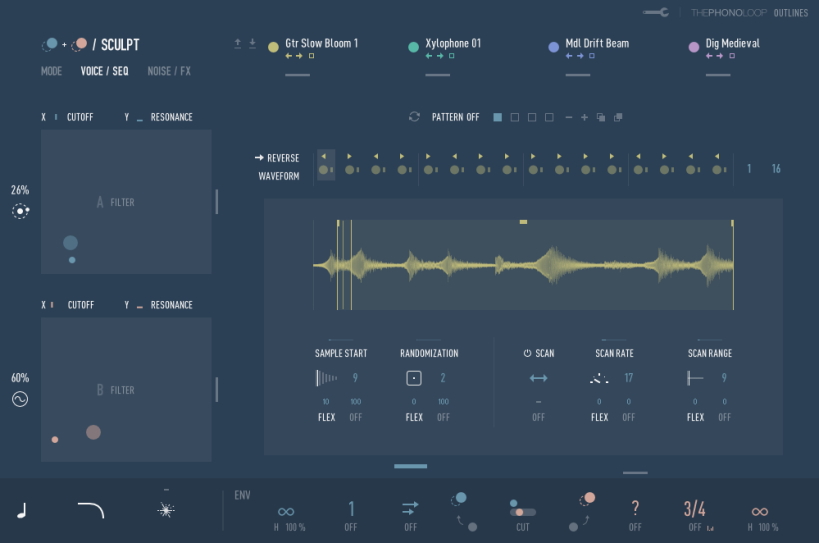
Thephonoloop announces the availability of outlines as its latest NKS (Native Kontrol Standard) ready VI (virtual instrument) for Native Instruments’ Kontakt Player free sample player - beautifully blending raw acoustic gestures with tape loops and modular-processed tonal experiments to spark musical momentum as the sample-based instruments with character-producing Polish two-person team’s approach to a collection of tonal variations designed to be combined and explored, each preset being an outline of a musical idea ready to be expanded and reshaped into something larger - as of March 12…
As an outline of a musical idea ready to be expanded and reshaped into something larger, each preset propelling outlines’ openly creative collection of tonal variations duly designed to be combined and explored is a result of Thephonoloop spending some serious time gathering suitable source material - think ACOUSTIC (119 sources), MODULAR (139 sources), SYNTH (67 sources), TAPE LOOP (65 sources), VARIOUS (six sources), and many more besides, focusing on texture, detail, and contrast, creating a wide range of acoustic and synthetic sounds that can interact and form unexpected combinations.
Creatively speaking, flutes, mallet instruments, strings, and other small acoustic sources were recorded up close to capture the subtle gestures of the instruments concerned. Thephonoloop took it slow in the process of doing so, taking time to uncover hidden gems and embrace happy accidents along the way, with air, creaks, field ambience, finger noise, and room ambience all treated as honorary guests rather than trespassers - the library would not have existed without them. These recordings were further blended with analogue and digital synthesis, modular experiments, and tape loops to form the palette of textures from which the sounds of outlines emerged.
Experimenting with different microphones during the sessions themselves, Thephonoloop chose carefully, complementing the character of each instrument and the textures it wanted to capture. Indeed, it even deployed a pair of ultrasonic microphones capable of recording frequencies up to 100kHz, producing results with exceptional detail. Much material was captured at 192kHz, in fact, allowing the recordings to be significantly slowed down, readily revealing layers of resonance and texture that would otherwise have remained unheard.
Working with modular systems is a natural part of Thephonoloop’s production process, so bringing them into the creation of outlines was inevitable. After all, processing and resampling sound has long been part of its sonic language, adding another layer that complements and contrasts with the raw acoustic recordings. Recording a separate set of acoustic material, these sounds - together with recordings of analogue and digital synthesisers - were mangled through delays, filters, granular processors, physical resonators, reverbs, and samplers. Since this process often pushed the material far beyond its original form, transforming it into evolving textures and tonal variations that sit somewhere between the source and something entirely new, every experiment helped shape outlines into what it became.
It is fair to say, though, that cassettes and tapes are another essential part of Thephonoloop’s DNA as one of the most inspiring ways to generate material that feels organic, slightly unpredictable, and full of subtle movement - often contrasting beautifully with the modular systems, raw recordings, and synthesisers. Working with real tape is something that Thephonoloop thoroughly enjoys doing - not only because of the sound it produces, but also because of the completely different workflow it invites. It demands attention and patience, but more often than not rewards that time with moments that are almost impossible to plan.
Put it this way: while all of those approaches are integral to outlines, ambience, noise, and subtle textures form another important layer of its palette, without which it would feel incomplete. It is just as well, then, that a large part of the recordings were captured with microphones capable of reaching far beyond the usual frequency range. Exploring environmental sounds and delicate textures, this extended spectrum revealed details and movement that would normally remain hidden. It is for this reason that - alongside traditional microphones — Thephonoloop also used contact microphones to capture vibrations directly from objects and surfaces. Such recordings often uncovered quiet movements, micro-textures, and small resonances, adding another layer of character and depth to the material.
Sonically speaking, outlines’ engine is built around two independent granular layers, letting two different playback approaches - ANIMATED and SINGLE - run side by side. Since each layer runs on its own engine, it is possible to combine traditional polyphonic playback with granular or sequenced movement, meaning users can run two animated/granular layers, two polyphonic layers, or blend both approaches together. The layers can complement, contrast, or interact with each other, opening up a wide range of paths to explore. And as if all that was not enough to be getting on with, the engine also features a system of five different instrument modes - namely, DUETS, LENGTHS, ORBITS, SCULPT, and SINGULAR — that are designed to offer speedy starting points and keep the workflow intuitive while still encouraging deeper sound exploration.
Each layer features its own 16-step polyphonic sequencer (SEQ) - available in both playback modes - that can also function as a voice-specific modifier rather than only acting as a traditional step sequencer. Ultimately, users can reshape playback in many different ways - assigning different sample start positions per note, detuning parts of the sequence, reversing certain notes, shifting selected steps up an octave, and switching sound sources across notes, for example. Each sequencer can also store four independent patterns that can be modulated or switched in real time. This makes it easy to introduce evolving movement and variation during performance. Paired with the dual-layer engine, the sequencers can introduce more complex evolving patterns or subtle variations, spanning shifting granular textures to simple melodic gestures.
Getting to grips with outlines offers openly creative access to those beautifully blended raw acoustic gestures with modular-processed tonal experiments and tape loops that spark musical momentum, readily representing Thephonoloop’s approach to a collection of tonal variations designed to be combined and explored, each preset being an outline of a musical idea ready to be expanded and reshaped into something larger for anyone buying into it.
outlines is available to purchase at an introductory promo price as an NKS (Native Kontrol Standard)-ready virtual instrument plug-in comprising 2,509 samples equating to a 7.81GB download (after NCW - Native Instruments Comprised Wave - compression) with 438 presets for Native Instruments’ Kontakt Player 7.10.7 (or higher) or on macOS 12, 13, 14, and 15 (latest update) and Windows 10 or 11 (latest Service Pack) directly from the dedicated product webpage.