 How to resolve AdBlock issue?
 The Crow Hill Company ARCANE STRINGS
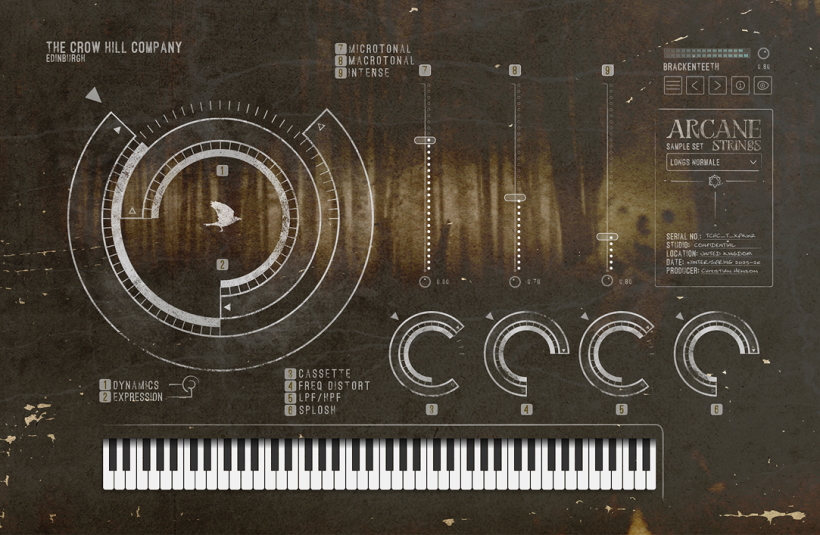
Readily representing its first ‘big’ release in over a year (when the temporarily out-of-circulation GLASS STRINGS was effectively re-released with a totally redesigned GUI and added features as the Edinburgh-based enterprise’s workhorse string library for a new era in more human-sounding music and scores, coinciding with rebranding itself with an aesthetic that truly realised company co-founder and composer Christian Henson’s heartfelt dream of encouraging people to make music and help them on their journey, regardless of whatever point they were at and wherever their journey began), The Crow Hill Company announces the availability of ARCANE STRINGS - taking the sampling rule book and ripping it up, ultimately resulting in a string library featuring amateur players in order to achieve an arcane, primitive, dislocated, microtonal, loose, and sometimes savage sound duly designed for media composers wanting to leave a truly characterful imprint on their next drama score, or, indeed, composers who want to gain extra devilish bite out of their existing string collections - as of August 14…
You may not like this. A new orchestral plug-in that sounds like strings bowing barbed wire with rusty hair. Microtonal and loose. Undisciplined and raw. Designed by composers for composers. (But not to everyone’s taste.) The Crow Hill Company’s scene-setting opening credits to its official walkthrough video for ARCANE STRINGS serve it well. What does its principal protagonist have to say when starting to play with it on camera? “Oh, you are a naughty boy!” But does this excitable quote refer to the library itself or, perhaps, company co-founder and composer Christian Henson himself? However, one thing is for sure. Ripping rule books - sampling or otherwise - up is almost always a brave move. Maintains Christian Henson: “I’m genuinely quite nervous about bringing this plug-in out into the big, bad world, but I’ve always maintained - with music and sound - that if you make it for yourself then at least one person is going to like it. What I’m delighted about is that it is the sound I heard in my head - not necessarily one that everyone is going to like.”
Continues Christian Henson, digging deeper into making ARCANE STRINGS in the process of doing so: “The central idea behind this library is to take strings beyond where professionals are prepared to take them - to create something unrefined, unblended, loose, microtonal, and, at times, unpleasant, but without it just being another horror library. It’s a baritone library, as I’d describe it, so basses, cellos, and violas. I’ve been quite excessive with the amount of sampling - the longs are long! We calculated that there’s about 40 minutes of performance per pitch centre, so you don’t really hear the loops with the longs. The OSCILLATIONS, for instance, don’t really sound like loops. But, unusually for a characterful library like this, it’s not two dynamic layers - not three, but four. So, to get the most out of it, make sure you’re using your velocity [EXPRESSION] layers and your [DYNAMICS] crossfade mixer or automation. Also, the playing styles will denote where presets have key switches that switch between different performances. What I hope you will find - and it was definitely an ambition for the library - is that they almost behave like brass, so when you want to take your music and give it that bite without going to [American saxophonist, composer, and bandleader] Branford [Marsalis], this is a new alternative. Whereas a lot of string libraries have a mixer for different mic positions, this has what I refer to as ‘partials’ so each of the three faders is part of the sound and represents a different part of the performance, starting with MICROTONAL [7], where it’s had a degree of pitch processing in post production to pull the players together. And when I say players, there are some professionals in there, but what you’ve also got is 70 of me playing basses, cellos, and violas. There were points that the engineer, Stuart [Hamilton], at Castlesound [Studios] said to me, ‘I simply don’t know what we’re doing!’ MICROTONAL [7] is the most neutral signal from a sonic perspective, so intimate and warmer sounding than our MACROTONAL [8] signal, which has less post production from a pitch point of view and, therefore, through the powers of hysteresis - the effect you feel when the larger a group of players gets, the less accurate and defined the sound becomes - and by letting the pitch do its naughtiness what you get is not only more sense of scale but more sense of width as well. You’re hearing every player, which is what gives it that scale of band, but you can still hear each voice, for want of a better word, in there, and that there’s quite a lot of them! The third partial [INTENSE 9] is a more processed sound - really closed mic’d, compressed and smashed to pieces with a bit of hyping EQ on it as well through some posh outboard. When you add them all together, you get this absolutely enormous scale.”
Interestingly, included in ARCANE STRINGS are no fewer than 19 articulations or playing styles that are sure to pique peoples’ interest. In the wise words of the ever-creative Christian Henson, highlighting but a few, “RUSTY LONGS are quite an honest-sounding long - because I’m not playing with vibrato, it has a viola-like quality; ASHEN LONGS have a more Sul Tasto-y vibe, without it going fully into the well-trodden mossy landscape of Scandi - more the misty marshes of, say, Suffolk; OSCILLATIONS, these will sync to your host tempo, but unlike other motor libraries - some of which we’ve made, it’s looser around the meter to give more of a natural, less phrase library kind of sound to it - something that moves, and then the more you push the dynamic layer, the more defined that meter becomes; there’s free trems - what I call STORM TREMS because they create a rumble - where you can still hear the individual players, though, because that’s what I’m interested in; BREATHS are kind of like the OSCILLATIONS - they don’t synchronise since they’re not playing in time with each other, so they just create this beautiful motion; GASPS are aleatoric - won’t go in time with your computer, and, again, they’re long, so you don’t hear the loops, looping at different points; STRIKES really are quite long, with lots of round robins - up to seven, and I’ve kept the stuff that happens after hitting a strike - sometimes there’s an extra note or something, and it reminds me a little bit of thunder, where it’s not just the crack but also the echo as it bounces off hills and stuff; between those STRIKES and GASPS we’ve also got these incredible ARCANE STRIKES, which is a very specific shape, so be certain to play well ahead of the beat when you’re trying to make these hit a beat; and, finally, some PLUCKS, which are highly unusual - not surprising, considering the player!”
ARCANE STRINGS is available to purchase - priced initially with a so-called Early Access offer of £109.00 GBP until midnight BST (British Summer Time) on September 1, 2026 (rising thereafter to its regular price of £149.00 GBP) - as a sample-based virtual instrument comprising 6 GB of uncompressed audio (compressed lossly to 3 GB) supporting AAX-, AU-, VST-, and VST3 plug-in formats for macOS 12 through to 15 (Apple Silicon and Intel compatible) and Windows 10 through to 11 with up to four dynamic layers, up to seven round robins, three mixable unique ‘partials’, 19 articulations, and four specially curated effects macros (CASSETTE - unique tape effect taking a turn for the worse; FREQ DISTORTION - designed specifically with a combination of LPF and clipping; LPF/HPF - controlling searing brightness; and SPLOSH - reverb) - from The Crow Hill Company.