 How to resolve AdBlock issue?
Analogue Solutions Series 700
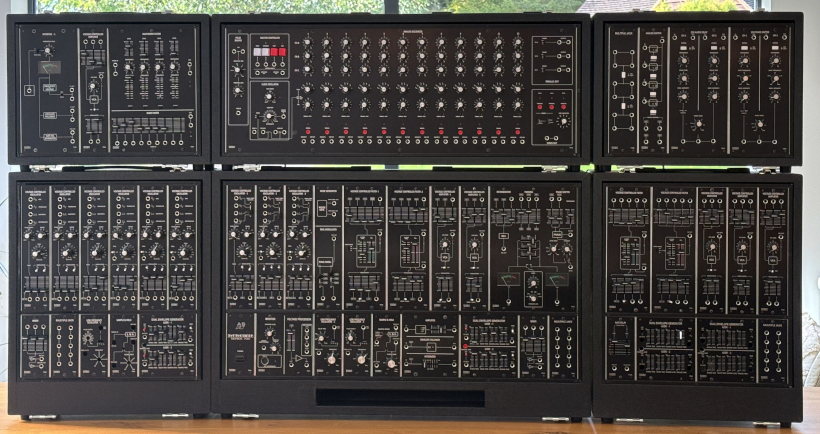
Following its inauguration with a successful showcase at Synthfest UK in Sheffield on October 24, 2026, achieving another of its industrious creator’s ‘giant leap for synthkind’ style grand gestures that bravely brought into being the likes of the top-tier Colossus, Maximus, and TC5000 families of mega-synths, all adhering to an admirable design ethos truly taken from the dawn of analogue synths, British boutique electronic instruments innovator Analogue Solutions signals that its six-block Series 700 professional modular synthesiser — recreating Roland’s rarefied System 700 (originally billed by the Japanese giant as being a complete studio system that could be built piece by piece) in all of its glory, getting as close to the coveted mid-Seventies-vintage design as humanly possible — is available for pre-order, as of October 29…
An appreciation of the amazing achievement that is Analogue Solutions’ Series 700 benefits, beyond any doubt, from an appreciation of its inspiration’s illustrious history. Roland’s revered, not to mention rarefied, System 700 was the most expensive synthesiser that the Japanese giant ever made — markedly more so than the company’s classic Jupiter-8 analogue programmable polysynth that dominated charts and stages throughout the early Eighties. Even though the System 700’s six so-called blocks could be bought separately to create a complete studio system, inevitably it ended up in the hands — and studios — of a privileged few from the outset. Against all odds, it forever made its mark on the popular musical landscape when playing a prominent part in synth-pop pioneers The Human League’s landmark Dare album’s chart-topping escapades, essential record producer Martin Rushent’s Genetic Sound studios-residing System 700 being credited on the original 1981 album sleeve notes, for instance. It was, and still is, a premium professional system. Today they can change hands for over £150,000.00 GBP on the second-hand market — assuming that a full system can actually be found anywhere! And even if a System 700 is found, it is usually only a partial system so finding any missing blocks to complete it is nigh on impossible.
It is just as well, then, that Analogue Solutions has bravely brought its Series 700 into being, sinking a serious sum into doing just that. The end result is as close to the Roland System 700 as it is possible to get. After all, Analogue Solutions aimed to replicate the coveted mid-Seventies-vintage design as closely as possible. Put it this way: the British boutique electronic instruments innovator’s dogged pursuit of retaining the original’s distinctive look and layout even extended to having custom-made knobs — including dual-concentric fine/coarse tune controls for the VCO (Voltage-Controlled Oscillator) waveforms — and slider caps, as well as custom-ordered switches and potentiometers. And although mechanical changes have been applied internally, these do not, of course, change the sound.
Saying that, though, with the benefit of modern hindsight, there are now better ways to achieve this undertaking, both externally and internally. Indeed, a different choice of circuit types and layouts would be preferable, perhaps, but Analogue Solutions stayed true to the original spec, so almost every circuit has been reproduced from original schematics with changes being kept to an absolute minimum, made only where necessary. Needless to say, the original mid-Seventies-vintage design uses many components that are no longer available, so changes were only made where it was impossible to source specific parts. Persistently resisting the urge to change the spec or feature set, Analogue Solutions only added a basic single-channel MIDI-to-CV converter — primarily for syncing the 3 x 12-step analogue CV sequencer to MIDI.
Mirroring the palatial physical proportions of Roland’s mid-Seventies-vintage design, all of Analogue Solutions’ Series 700 blocks are a like for like match, size-wise — specifically, Block 1 (Main Console): 860 mm (W) x 560 mm (H); Block 3 (Analogue Sequencer): 860 mm (W) x 362 mm (H); Block 4 (VCO Bank): 460 mm (W) x 362 mm (H); Block 5 (VCF/VCA Bank): 460 mm (W) x 362 mm (H); Block 6 (Interface/Mixer): 460 mm (W) x 362 mm (H); Block 7 (Phase Shifter/Audio Delay): 460 mm (W) x 362 mm (H), all sharing the same 310 mm (with lid)/255 mm (without lid) depth. Anyone astutely wondering what happened to the ‘missing-in-action’ Block 2 should note that this is the 701 keyboard controller that Analogue Solutions is in the process of developing separately — based on Roland’s original 701A 61-key two-voice affair, but blessed with four-CV-channel polyphony, velocity CV output, and MIDI in/out, plus minijack connections that can also be used with Eurorack and other modular synths, as well as vintage monosynths — for future purchase when available as an optional upgrade.
But breaking those already available blocks down into their individual modules makes it plain for all to see just how powerful the six-block Series 700 professional modular synthesiser surely is: Block 1 comprises 702A (VOLTAGE CONTROLLED OSCILLATOR -1), 702B (VOLTAGE CONTROLLED OSCILLATOR -2), and 702C (VOLTAGE CONTROLLED OSCILLATOR -3), 708A (NOISE GENERATOR/RING MODULATOR), 703A (VOLTAGE CONTROLLED FILTER -1 — multimode), 703E (VOLTAGE CONTROLLED FILTER -2 — lowpass), 704A (VOLTAGE CONTROLLED AMPLIFIER -1), 704B (VOLTAGE CONTROLLED AMPLIFIER -2), 711A (REVERBERATOR/PANNING/PHASE SHIFTER/VU meters), 718A (POWER), 712A (MONITOR/MIDI/VOLTAGE PROCESSOR), 706A (LOW FREQUENCY OSCILLATOR -1), 706B (LOW FREQUENCY OSCILLATOR -2), 709A (SAMPLE & HOLD), 707A (AMPLIFIER/ENVELOPE FOLLOWER/INTEGRATOR), 705A (DUAL ENVELOPE GENERATOR), (MIXER — three channels), and 710A (MULTIPLE JACK); Block 3 comprises 717A (PULSE SHAPER/MASTER CONTROLLER/CLOCK OSCILLATOR/ANALOG SEQUENCER/PARALLEL OUT/SERIES OUT); Block 4 comprises 702D (VOLTAGE CONTROLLED OSCILLATOR) x3, 702E (VOLTAGE CONTROLLED OSCILLATOR) x3, 716A (MIXER — three channels), 710A (MULTIPLE JACK), 706B (LOW FREQUENCY OSCILLATOR -2), 709B (SAMPLE & HOLD), and 705A (DUAL ENVELOPE GENERATOR); Block 5 comprises 703F (VOLTAGE CONTROLLED FILTER — lowpass), 703C (VOLTAGE CONTROLLED FILTER — multimode), 704C (VOLTAGE CONTROLLED AMPLIFIER) x3, 713A (GATE DELAY), 705A (DUAL ENVELOPE GENERATOR), and 710A (MULTIPLE JACK); Block 6 comprises 714A (INTERFACE -1), 704C (VOLTAGE CONTROLLED AMPLIFIER), and 715A (MULTIMODE FILTERS — four/AUDIO MIXER); and Block 7 comprises 710B (MULTIPLE JACK), 723A (ANALOG SWITCH), 721A (2CH AUDIO DELAY), and 729B (2CH PHASE SHIFTER). It is worth noting here, however, that each block’s configuration is effectively set in stone, so to speak, so cannot be changed due to internal patching. And although Analogue Solutions does not presently plan to sell Series 700 modules on an individual basis for potential System 700 ‘transplantation’ purposes — all are the same size as Roland’s originals while their front panel sheen is also a perfect match, it should perhaps be borne in mind that a space may well be needed and that the provided power connector would need to be adapted accordingly.
Analogue Solutions’ admirable attention to detail apparently knows no bounds, for each Series 700 block’s cabinet — crafted as a Tolex-wrapped wooden box with a strap carry handle — comes complete with a lid lined in a beautiful blue-coloured material, just like Roland’s System 700. Similarly, their latches and hinges are remarkably close to those used on the original System 700, while Block 1 retains the letterbox-style slot for cable or manual storage. Since the spec of the Series 700 is almost identical to that of the original System 700, the British boutique electronic instruments innovator is not planning on writing a full-blown manual for its latest and, possibly, greatest mega-synth offering to date — Roland having already done a decent job of explaining its coveted complete studio system back in the Seventies — but rather uploading the original System 700 manual alongside a supplementary Series 700 manual highlighting any important differences between the two. Talk about hitting the mark — musical or otherwise — with its recreation of one of the most revered, not to mention rarefied, premium professional systems of all time.
The full six-block Series 700 professional modular synthesiser is available for pre-order — it is also possible to individually pre-order Block 1 (Main Console); Block 3 (Analogue Sequencer); Block 4 (VCO Bank), priced at £7,000.00 GBP; Block 5 (VCF/VCA Bank); Block 6 (Interface/Mixer); and Block 7 (Phase Shifter/Audio Delay), or combinations thereof — directly from Analogue Solutions. (A deposit is required to hold a place in the build queue, with wait time depending on whether pre-ordering a full six-block Series 700 professional modular synthesiser, an individual block, or combinations thereof, as well as queue position — possibly 2-3 months; either way, Analogue Solutions will send payment details for the deposit required, together with an approximate build time and shipping cost.)