 How to resolve AdBlock issue?
 Analogue Solutions Filtopia
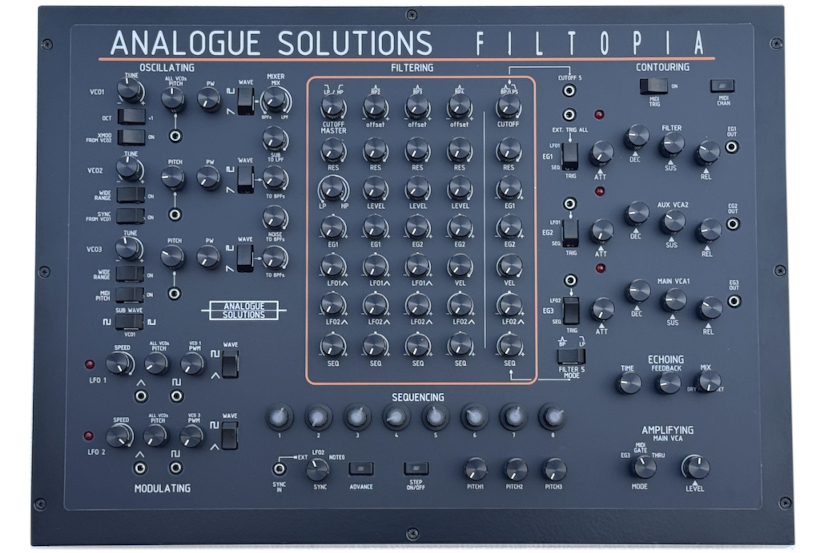
Having more recently focused its not inconsiderable talent on making ear- and eye-opening grand gestures with the likes of its Colossus, Maximus, and TC5000 families of mega-synths all adhering to an admirable design ethos truly taken from the dawn of analogue synths, British boutique electronic instruments innovator Analogue Solutions announces that it is shipping an eagerly-awaited second batch of the limited-edition Filtopia as a more manageable though no less impressive sounding stereo analogue monosynth - anchored around a FILTERING bank boasting five parallel analogue filters for dense harmonic sculpting, multi-band frequency sweeps, and acoustic vocal formant emulations - that speedily sold out of its initial 50-unit batch within days of being announced, as of October 6…
USP (Unique Selling Point) is arguably an oft-overused acronym. Analogue Solutions’ Filtopia flies in the face of convention with its bank of five analogue filters wired in parallel - making multi-band filter sweeps a glorious possibility, while, with some tweaking, vowel-type sounds can also be crafted - clearly setting it apart from the sound of the (analogue) crowd. Creatively pairing offset filter cutoff frequencies with some high RES (resonance) levels means that those five filters can mimic the way the human voice works - something that cannot be done with a single filter.
Digging deeper into the FILTERING bank that is Filtopia’s key USP, the first (far left-positioned) filter has a balance level control that fades between LP (low-pass) and HP (high-pass) filtering; the second, third, and fourth (middle) filters are all BP (bandpass) affairs; and the fifth (far right) filter’s CUTOFF control is switchable between BP and LP. And all five filters are of the 12dB/Oct variety, their origins being traceable back to Oberheim’s 1974-vintage SEM (Synthesizer Expander Module) - seriously sought after as a classic, albeit adapted somewhat to better suit Analogue Solutions’ sound and aims.
Aside from its uniqueness of being blessed with that multi-channel FILTERING bank allowing for some very unique and extreme filter sweeps enhanced by complex modulation options - the first two filters are assignable to EG1 with a -/+ control for inverted and positive modulation, the third and fourth filters are assignable to EG2 in the same way, while the fifth filter is assignable to both EG1 and EG2; and all five filters are assignable to LFO 2, also with a -/+ control for inverted and positive modulation, the first three filters are assignable to LFO 1 in the same way, while the fourth and fifth filters feature VEL (velocity) level controls — resulting in a degree of ‘happy accidents’ in sound design, which can be a good thing in itself, Filtopia is fully loaded with VCOs (Voltage-Controlled Oscillators), LFOs (Low Frequency Oscillators), and EGs (Envelope Generators).
The three VCOs in its OSCILLATING section are equally flexible. For example, VCO1 can be routed via its MIX control to all the BPFs - filters one through to four in the left position, in other words, while turning that control to the right routes the signal to the LPF option (filter five). Furthermore, the SUB TO LPF control indicates that Filtopia’s welcomed sub-oscillator can only be routed to filter five’s LPF, while the NOISE generator, VCO2, and VCO3 can only be routed to the BPFs (filters one through to four). As a result of a carefully considered design decision to give those audio sources slightly different options, Filtopia users can choose to have some signals being filtered in a different way by a different filter, giving an impression of multiple synthesisers playing in unison.
Flexibility further abounds in the fact that Filtopia is, in effect, capable of stereo sounds thanks to its dual high-headroom VCAs (Voltage-Controlled Amplifiers) optimising full spatial separation and stereo panning accuracy. As such, MAIN VCA1 and AUX VCA2 each have their own ¼” jack output, the former’s level being controlled by EG3 and including the ECHOING section’s audio - itself derived from an onboard solid-state delay block for retro space, depth, and feedback loops - while the latter’s dry signal level is controlled by EG2; panning the two output jacks and varying the EG2 and EG3 settings results in some wonderful-sounding sweeps.
And as if all that was not enough to whet any serious synth enthusiast’s analogue appetite - after all, Filtopia is real analogue, meaning that, like all Analogue Solutions electronic instruments before it, the entire audio path and all modulation is entirely analogue, so no CPU (Central Processing Unit) stabilised and quantised circuits, no DCOs (Digitally-Controlled Oscillators), and no digital EGs, as is often the case with many so-called analogue synths - then further features to musically meditate on include an integrated step-based CV (Control Voltage) SEQUENCING section providing per-step pitch customisation and dynamic performance controls; a dedicated input routing matrix capable of running external synths, drum machines, or line-level tracks directly into the filter array; front panel-positioned standard mini-jacks maximising custom CV routing control and seamless interaction with Eurorack hardware units; and last, but by no means least, hybrid connectivity options facilitating clean communication between classic hardware environments and modern DAW (Digital Audio Workstations).
With all that being said, then, the final word rightfully rests with the far from word-shy Analogue Solutions Director Tom Carpenter, creator of Filtopia and, it goes without saying, an analogue aficionado of some standing: “We have given this synth a large and diverse number of controls that, alongside the patch sockets, will give even the best and experienced synthesist endless possibilities. It is for use any time you need analogue sound effects, fat basses, screaming leads, beeps, zaps, and all the other crazy sounds associated with analogue synthesis - use in place of boring digital synths and DSP [Digital Signal Processing] soft synths! Continuously tweak and you will stumble upon endless new and unique sounds. It has such a wide range of modulation routing possibilities that it is almost as versatile as a full modular and can produce the same types of sounds, without the mess and confusion of cables. Even so, it has a large selection of patch sockets that enable you to re-patch itself or connect it to an external modular. It can also be used by MIDI and CV at the same time! So you could have an analogue step sequencer playing a little melody, then, using a MIDI [Musical Instrument Digital Interface] keyboard or MIDI sequencer, transpose the analogue sequence. It has an AUDIO IN socket, so you can feed external sounds through the onboard analogue filters for analogue processing. No compromise has been made with the construction of Filtopia; it combines all the often-needed electronic circuitry to make a powerful music synthesiser in one compact module.”
Whichever way anyone chooses to view it, one thing is for sure: anyone - analogue aficionado or otherwise - wishing to add a limited-edition Filtopia to their set-up best be quick in securing an order from Analogue Solutions’ second batch if the staggering speed at which its initial 50-unit batch sold out in July 2026 is anything to go by.
Analogue Solutions is intending to only build 200 units of its limited-edition Filtopia stereo analogue monosynth, available to order from the now-announced second batch directly via its dedicated webpage, with stock soon arriving at selected dealers.