 How to resolve AdBlock issue?
 L-Acoustics Digital Construction
Picture: Luke Dyson
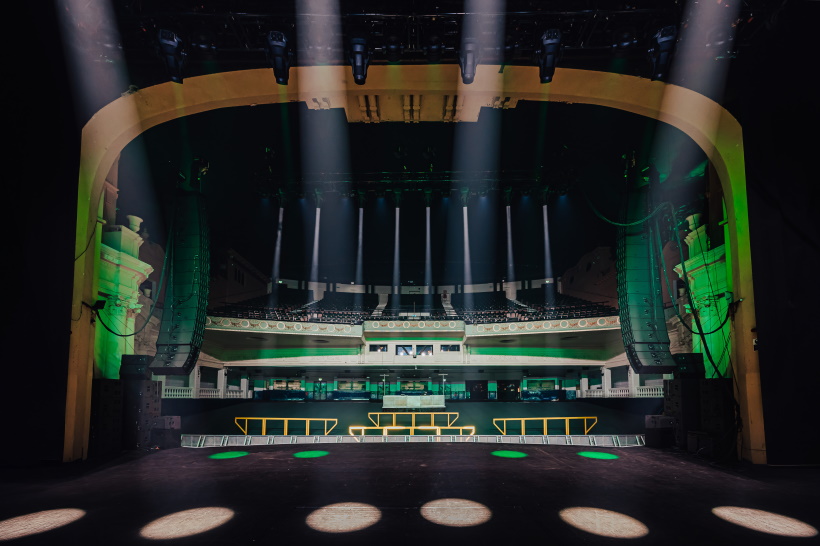
Every sound system design starts with a model of the space, and that model is only as accurate as the information behind it. In many venues, the architectural drawings used to build the model are incomplete, out of date, or never matched the finished building. Renovations, retrofits, and years of small modifications widen the gap between what appears on paper and what exists on site. When a design rests on inaccurate geometry, the cost shows up late: coverage that behaves differently than predicted, rigging that does not fit the structure, and changes that have to be resolved during installation.
Digital Construction includes an on-site scan carried out by an expert L-Acoustics Application Engineer that includes stage areas, balconies, and the spaces that connect them, using handheld LiDAR. The method records the room in high resolution far faster than manual measurement and captures detail that less advanced methods like hand drafting or P2P laser can miss. It is built for the scale of professional venues, where the short-range scanners found in consumer devices, limited to roughly five meters, cannot cover the space. The result is a true-to-life record of the room as it actually stands.
Each scan is verified and processed through a standardized workflow with quality checks at every stage, so results stay consistent from a small club to a stadium bowl. Clients receive two deliverables: a detailed point-cloud file of the venue for their own reference, and a simplified, Soundvision-ready model for acoustic simulation and system design. Post-processing scales with the size and architectural complexity of the venue, and the L-Acoustics team works with each client to set a realistic timeline before work begins.
Digital Construction strengthens the first step of every design by making sure the model reflects the real room before any loudspeaker is specified. It works alongside the Soundvision tools and Architectural Drafting services that L-Acoustics teams and partners already use, giving Certified Providers, AV consultants, and venue owners an accurate as-built reference. The benefit is clearest in renovations, older buildings, and venues without reliable documentation, where verified geometry reduces the risk of late surprises, such as unexpected ceiling structures, rigging constraints, or sightline conflicts.
As the only loudspeaker manufacturer to offer as-built LiDAR capture at full venue scale within its design workflow, L-Acoustics ensures that the precision of Soundvision begins with accurate venue geometry. An accurate model of a venue also outlives a single project. The same as-built data supports future upgrades, clearer communication between stakeholders, and the growth of the L-Acoustics venue database that designers draw on worldwide.
"In addition to pure design problems, the issues caused by inaccurate drawings also mean that the Autofilter algorithm takes into account those inaccuracies, which can result in suboptimal front-to-back tonal and level balance. Digital Construction brings total accuracy to the foundational geometry for which a system design is produced, ensuring each client receives the absolute best result possible, leveraging our seamless workflow through design phases, to deployment, calibration, and every show beyond," says Asher Dowson, Director of Product Management, Services at L-Acoustics.
Digital Construction is on show at InfoComm 2026, June 17 to 19 at the Las Vegas Convention Center, where the L-Acoustics team will be on hand at booth N6336 to discuss the service and answer questions. Digital Construction is available to clients from the first day of the show.